 learndesign
Fasteners, explained
How to read a screw or bolt by its head, drive, thread, length and material, so you can name it, find a match, and take a product apart without stripping anything.
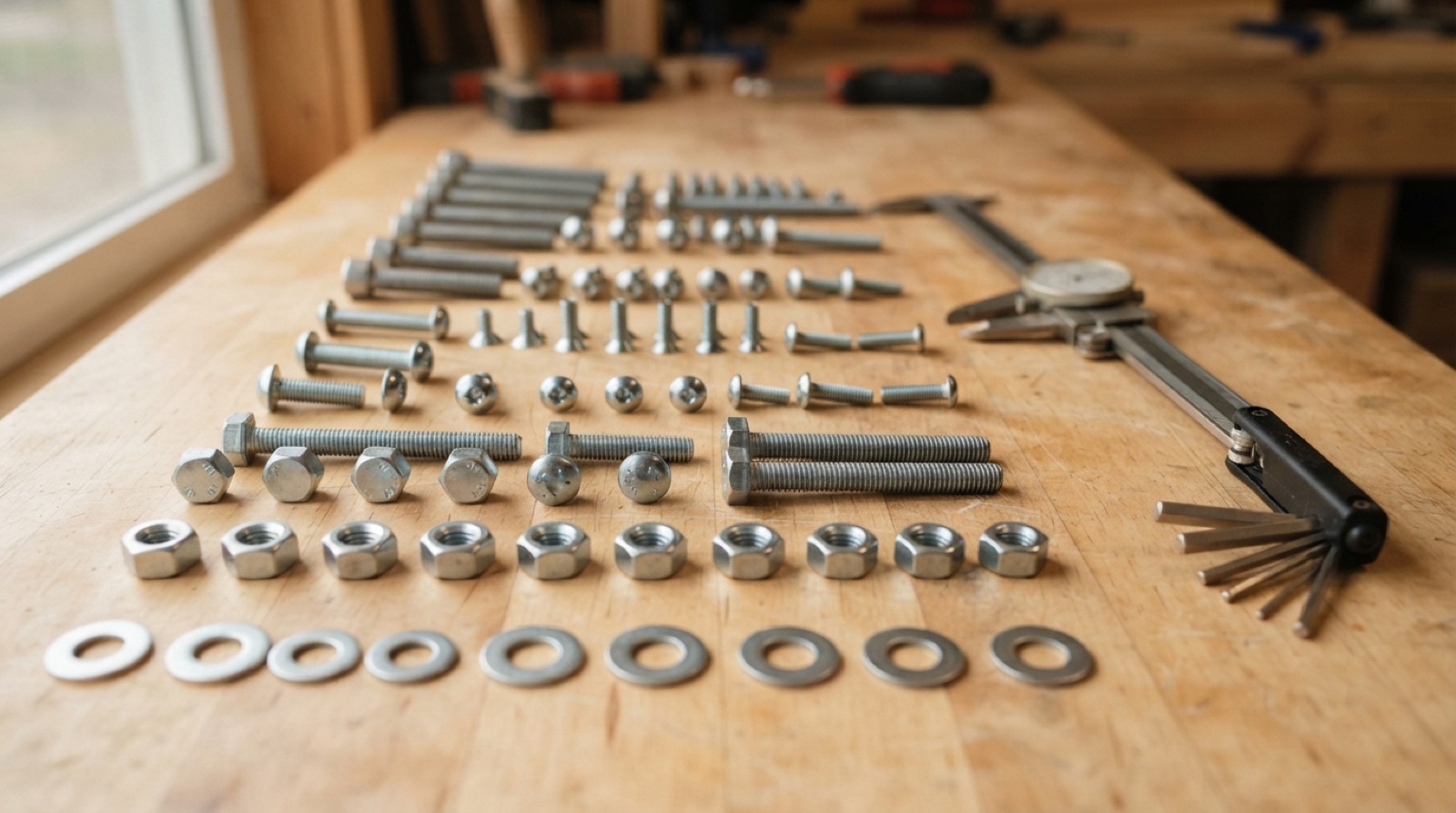
Every screw is described by the same five things: its head, its drive, its thread, its length and its material. Get all five right and anyone can find the exact part you are holding. Get one wrong and it will not fit, or it will strip the first time it is tightened.
Screw or bolt?
A bolt passes through the parts and a nut clamps them together. A screw threads into one of the parts. The same fastener can be either depending on how it is used, so most people call anything with a head and a thread a screw. What matters more is what the thread is made to go into.
Thread-forming screws cut a fresh thread each time they are driven in straight. When one goes back into its old hole, turn it backwards first until it drops into the existing thread with a small click, then tighten. Sheet metal screws look like wood screws but are threaded all the way up to the head.
Head types
The head decides how the screw sits on the surface and how much of it shows. These are drawn from the side.
Drive types
The drive is the recess the tool fits into. Match the bit exactly. It should seat all the way down with no wobble. A bit that almost fits is how screw heads get stripped, and a stripped screw is usually where taking a product apart turns into breaking it.
Threads
A thread has two numbers that matter. The diameter is measured across the outside of the threads. The pitch is the distance from one crest to the next.
Metric threads
Metric screws are written as M, the diameter in millimetres, then the pitch: M4 × 0.7. Every size has a standard coarse pitch, and when the pitch is left off, coarse is assumed, so an “M4” is an M4 × 0.7. Fine threads exist (M4 × 0.5) and always state their pitch.
| Size | Coarse pitch | Tap drill | Hex key, socket cap | Hex key, button and countersunk |
|---|---|---|---|---|
| M3 | 0.5 mm | 2.5 mm | 2.5 mm | 2 mm |
| M4 | 0.7 mm | 3.3 mm | 3 mm | 2.5 mm |
| M5 | 0.8 mm | 4.2 mm | 4 mm | 3 mm |
| M6 | 1.0 mm | 5.0 mm | 5 mm | 4 mm |
| M8 | 1.25 mm | 6.8 mm | 6 mm | 5 mm |
| M10 | 1.5 mm | 8.5 mm | 8 mm | 6 mm |
The tap drill is the hole you drill before cutting a thread into it with a tap. Electronics go smaller than the table: M2 (0.4 mm pitch) and M2.5 (0.45 mm) hold circuit boards and small modules.
Inch threads
Inch screws are written as a size and the number of threads per inch (TPI). A 1/4-20 is 1/4" across with 20 threads in every inch. Sizes under 1/4" use gauge numbers instead of fractions. UNC is the coarse series and UNF the fine one.
| Size | Diameter | Coarse (UNC) | Fine (UNF) | Where you meet it |
|---|---|---|---|---|
| #4 | 0.112" | 4-40 | 4-48 | Small electronics |
| #6 | 0.138" | 6-32 | 6-40 | Computer cases, 3.5" hard drives |
| #8 | 0.164" | 8-32 | 8-36 | General machine screws |
| #10 | 0.190" | 10-24 | 10-32 | Equipment racks (10-32) |
| 1/4" | 0.250" | 1/4-20 | 1/4-28 | Camera and tripod mounts (1/4-20) |
| 5/16" | 0.313" | 5/16-18 | 5/16-24 | Bolts in furniture and machines |
| 3/8" | 0.375" | 3/8-16 | 3/8-24 | Bolts in furniture and machines |
Measuring a thread
- Measure the outside diameter with calipers. Screws measure slightly under their nominal size, so 2.9 mm is an M3.
- Find the pitch with a thread gauge. Without one, measure across ten threads (eleven crests) and divide by ten. Ten threads over 7 mm is a 0.7 mm pitch.
- Measure the length: under the head for most screws, overall for countersunk ones.
- Check the hand. Almost every thread is right-handed and tightens clockwise. A few are left-handed on purpose, like the left pedal on a bicycle, which would otherwise unscrew itself as you ride.
Nuts, washers and inserts
- A hex nut is the standard partner for a machine screw. A nylon-insert lock nut (nyloc) has a nylon ring that grips the thread so vibration does not loosen it. A flange nut has a washer built in.
- A flat washer spreads the load under a head or nut, which matters most on wood and plastic. A split lock washer is the springy ring cut through on one side.
- Threaded inserts give soft material a machine thread. T-nuts and screw-in inserts go into wood. Brass heat-set inserts are pressed into 3D prints with a soldering iron; see Designing for FDM.
- Threadlocker is liquid adhesive for threads. Blue comes apart with hand tools; red usually needs heat. A screw that will not turn and has coloured residue in its thread has been locked.
Materials and strength
| Material | How to recognise it | Notes |
|---|---|---|
| Zinc-plated steel | Bright silver or yellowish | Cheap and common. Rusts once the plating wears through. |
| Black-oxide alloy steel | Dark grey to black, often a socket head | The strong ones. Usually class 12.9. |
| Stainless steel | Dull silver, only weakly magnetic or not at all | Resists rust but is not stronger than plain steel. A2 (304) for general use, A4 (316) near salt water. Stainless threads can seize if tightened fast and dry. |
| Brass | Yellow, non-magnetic | Soft. Used for electrical parts and heat-set inserts. |
| Nylon | White or black plastic | Does not conduct electricity, so it is used to mount and insulate circuit boards. |
Metric bolts are stamped with a property class on the head. In 8.8, the first number times 100 is the tensile strength in MPa, and the second is the fraction of that where the bolt starts to stretch permanently: 800 MPa, yielding at 80%. 10.9 and 12.9 are stronger again. Inch bolts use lines on the head instead: none for grade 2, three for grade 5, six for grade 8.
Fasteners you cannot see
When a product will not open, the fastener is usually hidden, or it is not a screw at all.
- Under things. Rubber feet, stickers, battery-compartment labels and trim strips all hide screws. Press on a label to feel for a hollow before you peel it, and peel only as far as you need.
- Snap fits. Plastic hooks moulded into the two halves of a case. Open the seam with a plastic spudger or pick and work your way around the edge. A metal screwdriver scars the plastic and snaps the hooks.
- Permanent joints. A plastic post melted into a mushroom over a part (a heat stake), rivets, glue, and ultrasonic welds, which leave a seam with no gap at all. These were not made to come apart. Often the right call is to leave that sub-assembly in one piece and label it as one part.
Before you start, search the product’s model number with “teardown” or “disassembly”. iFixit has step-by-step guides for thousands of products, and a video of someone else opening the same model shows where the hidden clips and screws are.
Keeping track during a teardown
- Bag screws by stage and write the stage on the bag, or push them through a sheet of cardboard in the pattern they came out, with the step written beside them.
- Screws from the same product often look identical but differ by a few millimetres of length. A long screw in a short hole can go straight through a circuit board or the outside of the case.
- Photograph each layer before you remove it.
Naming a fastener
Put the name together in the order a supplier lists it: thread size, length, head, drive, material.
- M4 × 12 countersunk hex socket screw, black oxide 10.9
- M2.5 × 6 pan head Phillips machine screw, zinc-plated
- #6-32 × 1/4" pan head Phillips machine screw
- #8 × 1-1/4" flat head Robertson wood screw
Wood screws are written as gauge × length, without a thread count.
Fasteners in Fusion
- Threads. Create → Thread adds a thread to a cylindrical face. Leave Modeled unticked and it is a cosmetic texture. Tick Modeled and the helix is cut into the solid, which you need if the thread is going to be 3D printed.
- Threaded holes. In the Hole tool, set the tap type to Tapped and choose the size, such as M4x0.7.
- Real parts. Insert → Insert McMaster-Carr Component places an accurately dimensioned screw, nut or washer in your design, so you can check lengths and clearances before buying anything.
- Modelling a screw you measured. A cylinder with the right diameter and length, and a head of the right shape and size, is a good model. The helix is optional. See Modelling from sketches for getting from caliper numbers to geometry.